

Manufacturing processes are quite complex, and the choice of a production method is directly related
Learn More →
For anyone engaged in manufacturing or machining, It is essential to know the CNC milling and CNC turning difference. Still, these two operations, though mostly linked to modern production, are quite different in their requirements and approaches. Let us tell you about it in a collaborative manner. Computerized numerical control (CNC) milling and CNC turning are both integral to the manufacturing industry but in vastly different ways and hence, it is a situation where you should understand them. The above discussions will serve as a very reliable foundation for building your preferences according to methods, characteristics, advantages, and applications which are likely to match your facility’s capabilities as established by you. Nevertheless, at the end of this exercise of comparing the two methods side by side, more astute comments might be made as regards your decision-making for the project or for the broader operational strategies. It is up to you to dive into the thrilling world of CNC milling and CNC turning together!

CNC machining, which means Computer Numerical Control machining, is a production technique that uses computer software programmed in advance to control the movement of tools and machines. This technology can be used to create parts from a variety of materials including metals, plastics, and wood with no precision, uniformity, and time. CNC machining has become a necessity in the aerospace, automotive, and medical industries because of its ability to provide very small and precise parts. The main processes in CNC machining are milling and turning. The former cuts the material from different sides and angles, while the latter uses a rotating tool on the surface of the material. Both methods provide a versatility and reliability that are helpful in their respective applications.
CNC milling is a process of manufacturing that removes material from a block to create three-dimensional objects via machines controlled by computers. The operation is subtractive and consists of using cutting tools to mill the material usually in three to five axes, depending on the complexity of the machine. Modern CNC milling machines are precision instruments and very adaptable; they can produce extremely intricate and top-quality items. This technique is extensively utilized in the creation of components for different sectors such as aerospace, automotive, electronics, and medical industries. The combination of software with CNC milling allows for effective design alteration, quick prototyping, and mass production; therefore, it becomes a significant player in the contemporary manufacturing trend.
CNC Turning is a process that provides precise results by the rotation of a workpiece on a lathe while the tool is cutting to the new shape of the workpiece. This method is usually employed in the manufacture of cylindrical or symmetry parts and its use is widespread in the automotive, aerospace, and medical device sectors. The introduction of computer numerical control (CNC) has turned turning operations into completely automated ones which result in more precise results, higher productivity, and more uniformity. The machines can carry out a wide range of operations that include threading, boring, and grooving as dictated by the pre-written software. CNC turning is very useful in prototype-making and mass production because it allows quick turnaround and extensive customization to meet specific design requirements.
Learning CNC techniques is a basic requirement for raising the level of manufacturing precision, productivity and flexibility. The well-trained people can generate the durable and difficult designs in a short time along with the waste and mistakes reduction. Knowledge of CNC means that one has a greater control over the cutting/turning/drilling process and hence it becomes feasible for manufacturers in the aerospace, automotive and medical devices sectors, which have high dimensional and complex requirements, to keep up with them. Moreover, being up-to-date with CNC technology allows companies to transition more easily into new tech areas such as AI and IoT which can result in higher operational efficiency and being able to compete effectively in the global market.
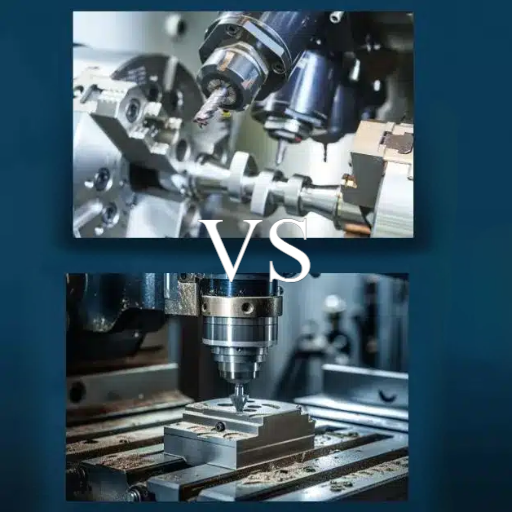
CNC Milling involves rotary cutting tools to remove material, while CNC Turning uses a stationary cutting tool where the workpiece rotates to shape material.
The technique of CNC milling and the method of CNC turning are quite different so far as the movement of tools and workpieces during machining is concerned. CNC milling method cuts the workpiece while holding it static with the rotating tool, which moves on the axis of the machine forming three-dimensional shapes by removing the material layer by layer. This makes it the best way for the most detailed components, like gears or cavities, to be made since they require very complex geometries.
On the other hand, CNC turning lets the workpiece revolve while the tool comes in and cuts the piece at a precise point. This method is primarily for creating cylindrical parts such as shafts or bushings and is characterized by super high accuracy. The customers often ask about the efficiency, complexity, and certain applications when they are choosing between the two processes. Both manufacturing processes meet different production requirements as CNC milling is more versatile, and CNC turning is creating high-precision cylindrical parts.
CNC milling is usually the ultimate technology in terms of intricate and multi-faceted designs when the complexity of parts is considered. It is capable of processing a wide range of shapes, such as complex 3D geometries, irregular contours, and detailed features like pockets, slots, and curved surfaces. In contrast, CNC turning is the best choice for simpler and more symmetrical parts and cylindrical shapes mainly. Although CNC turning can give rise to components with very high precision, it is still less capable of being intricate compared to CNC milling.
The decision between CNC milling and CNC turning in the context of material removal processes is largely dictated by the complexity of the design and the quality of the end product. The latest trends and data indicate that the CNC milling process is mainly preferred because it can efficiently remove the material from the workpiece that does not move while the cutting tool rotates. The intricate, multi-angled designs are where the precision and detail are the most crucial; hence it is an excellent choice. The creation of molds, intricate cavities, or highly specific contours are parts of the milling domain, as they require very complex geometries.
On the other hand, the CNC turning process is characterized by rotating the workpiece while the stationary tool cuts through and hence is the best option for making cylindrical or symmetrical parts. Throughout the process, the CNC lathe maintains speed and consistent quality, thus making it more productive for large volumes of such parts. Conversely, the major limitation of CNC turning for its not commonly being intricate is that its capabilities are reserved for simpler shapes only.
In the end, the milling or turning choice must be determined by the project’s specific requirements of shape, complexity, accuracy, and production volume. More and more often, industries use these methods as a pair for complementary manufacturing operations whereby the strengths of each are utilized thus enabling a more versatile approach to part production.
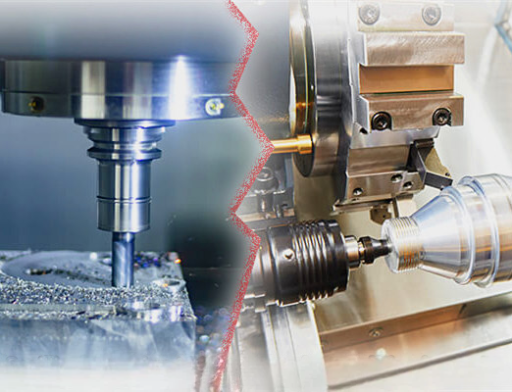
CNC milling boasts a high level of precision and versatility, hence it is a good choice in different industries. Below are the most common uses:
One reason for the popularity of CNC milling in the manufacturing sector is its flexibility, allowing it to be used where both precision and speed are required.
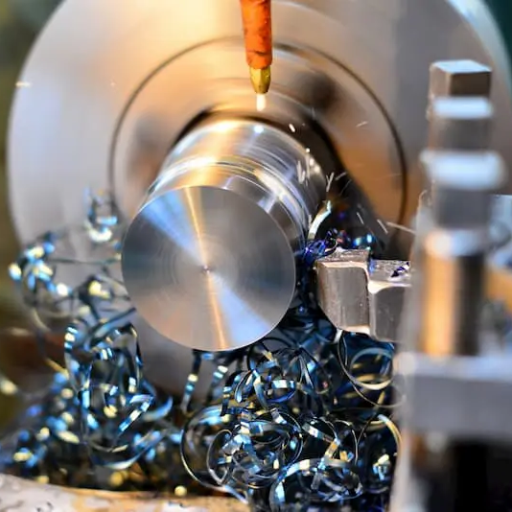
CNC turning is substantially accurate in manufacturing cylindrical parts and provides excellent repeatability tolerances, therefore becoming a key process across the industries.
CNC milling and CNC turning, both being highly efficient and accurate manufacturing processes, are suitable for a diverse range of industries. Here are some of the industries that gain from the employment of both techniques:
Taking advantage of the advantages of the processes, the manufacturers in these sectors can not only provide high-quality products but also do so with the highest efficiency possible, thus fulfilling the constantly increasing needs of innovation and customization.
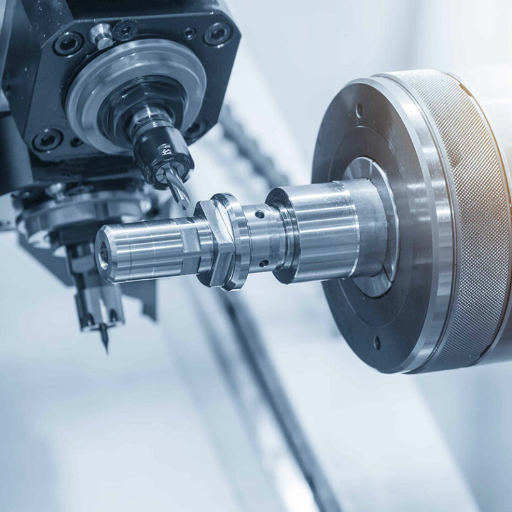
CNC turning and CNC milling can be a good combination, but the decision has to be made by evaluating the following factors first:
CNC milling is mostly used in projects that require very high accuracy and complexity in parts. This method is very good at making complex shapes, having very fine details, and setting very narrow tolerances that are almost impossible to obtain with other technologies. It is perfect for the aerospace, automotive, and medical devices, where precision and dependability are critical, industries. Moreover, CNC milling is suitable for a wide range of materials including metals, plastics, and composites, thus being very versatile in production. CNC milling is being increasingly utilized for tooling up and low to medium volume production runs due to its cost-effectiveness and outstanding precision. This makes it the choice of many manufacturers who want to maximize quality and efficiency at the same time.
CNC turning, to my mind, is the best option for making cylindrical parts or components with symmetrical features around a central axis. It is most often applied to shafts, bushings, and the like where high accuracy and uniformity are very important. I would suggest using CNC turning for small to medium-sized production runs or prototypes, particularly when dealing with metals or plastics. This technique shines in providing narrow tolerances and good surface quality, thus being applicable in automotive, aerospace, and medical markets. If you are looking for a method that combines efficiency and scalability along with high-quality standards, then CNC turning is the one to go for.
Effectiveness of CNC Turning and CNC Milling in Machining Process – A study analyzing the effectiveness of CNC milling and turning machines, providing insights into their applications and performance.
Virtual Machining Systems for CNC Milling and Turning Machine Tools: A Review – A comprehensive review of virtual machining systems for both CNC milling and turning, discussing their advancements and future research directions.
Comparison of Surface Roughness When Turning and Milling – A study comparing surface roughness outcomes between CNC turning and milling, using specific machining technologies.
A Review of Recent Application of Machining Techniques, Based on the Phenomena of CNC Machining Operations – A review of various CNC machining techniques, including milling and turning, and their industrial applications.
The two essential and widespread applications on CNC are milling and turning, the main difference being that in milling the rotating cutters do the cutting quickly while in turning the rotating workpiece is cut. Typically, CNC milling machines carry out milling operations while turning centers and CNC lathes are used to produce cylindrical parts. Both methods use a CNC program and advanced controls; the choice of CNC is determined by the geometry of the part and the tolerances set.
A lathe machine (or CNC lathe) mainly deals with turning: the workpiece rotates and the cutting tools shape it, which is advantageous for making shafts, threads, and round features. The milling process involves the use of rotating milling machines for cutting out complex profiles, pockets, and flat surfaces. The manufacturers rely on CNC lathes for producing high volumes of turned parts and CNC milling services when the parts require facing, plain, or precision milling — knowing the difference between the two, CNC turning and milling processes will guide you in the selection of CNC machining services.
There are several similarities between CNC milling and CNC turning, such as the fact that they both involve motion that is controlled by a computer, the cutting paths are set by a CNC program, and both are considered subtractive machining techniques. The equipment needed is the same for both processes (i.e., cutters, milling tools, or turning inserts), as well as the cooling method (i.e., cold air or liquid), clamps, and setup. They can be either offered through CNC machining services or combined CNC turning and milling machines for intricate parts.
Milling is the procedure that has to be selected when the component has been designed with flat edges, grooves, pockets, or intricate contours as they are produced with rotating cutters. When the part is largely cylindrical, then turning or using turning operations is recommended. For a CNC selection, the shape of the part, the quantity of production, the tolerances, and whether turning centers or milling machines are more suitable must be considered—generally, a shop will factor these elements into their CNC turning vs milling recommendation.
The difference is found in the usual surface finishes and tolerances: CNC turning is very good for generating concentricity and producing fine diameters, while CNC milling can be used for producing high detail and precision milling for complicated shapes. Precision milling with proper milling tools and cutters may attain extremely tight tolerances, and the integration of both on CNC turning and milling machines offers the best of both worlds for intricate parts.

Manufacturing processes are quite complex, and the choice of a production method is directly related
Learn More →
There are two major manufacturing methods for producing plastic prototypes that most people find useful
Learn More →
As a person involved or interested in the design and production of plastic components, it
Learn More →