

Manufacturing processes are quite complex, and the choice of a production method is directly related
Learn More →
Advanced custom turning parts are manufactured using Precision CNC Turning Services. This advanced manufacturing process is used for complex aerospace and automotive parts. Industries with stringent requirements rely on CNC turning due to its accuracy, repeatability, and versatility. In this case, we’ll discuss how Precision CNC Turning Services can enhance production capabilities for businesses, the advantages gained from utilizing them, and how they assist in achieving exceptional results during production. Learn how custom parts production can benefit from merging manufacturing technologies with skilled workmanship.
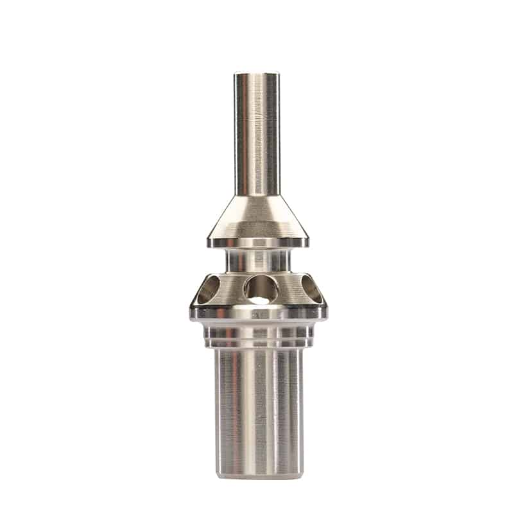
CNC Turning is a type of manufacturing in which a computer-controlled lathe turns out cylindrical parts with precision. It involves rotating a workpiece while a fixed cutting tool removes material to shape it according to the necessary specifications. Following a computer-aided design (CAD) file, CNC Turning delivers accuracy and precision during production. This method is particularly suited for fabricating shafts, bushings, and cylindrical portions. It remains a preferred approach for sectors that demand stringent tolerances and high productivity.
CNC machines develop turned parts using a sequential automated method that maintains accuracy and consistency. It begins with generating a digital design with specialized software like CAM or CAD. The design is then rendered into a G-code containing the machine tool’s movements and cuts. The workpiece is held onto the spindle of the lathe, rotating at a certain RPM. A cutting tool that is not moving but indexed as per the G-code will shave off materials to expose the shape and dimensions programmed. Some advanced CNC machines can carry out intricate designs with little to no supervision, thus proving very efficient and accurate, whether for prototyping or mass production.
Standard CNC turning tools include parting, facing, boring, chamfering, threading, knurling, and turning tools designed for shaping, cutting, or finishing a workpiece.
|
Tool Type |
Key Use |
Feature |
Material |
Precision |
|---|---|---|---|---|
|
Turning Tool |
Diameter reduction |
Linear motion |
Carbide, HSS |
High |
|
Facing Tool |
Flat surface creation |
Side cutting edge |
Carbide, HSS |
High |
|
Boring Tool |
Hole enlargement |
Single-point edge |
Carbide, CBN |
Very High |
|
Chamfering Tool |
Beveled edges |
Angled cutting |
Carbide, HSS |
Moderate |
|
Threading Tool |
Spiral threads |
Nose angle design |
Carbide, HSS |
High |
|
Knurling Tool |
Surface patterns |
Embossed rollers |
Steel |
Moderate |
|
Parting Tool |
Material separation |
Blade-like edge |
Carbide, HSS |
High |
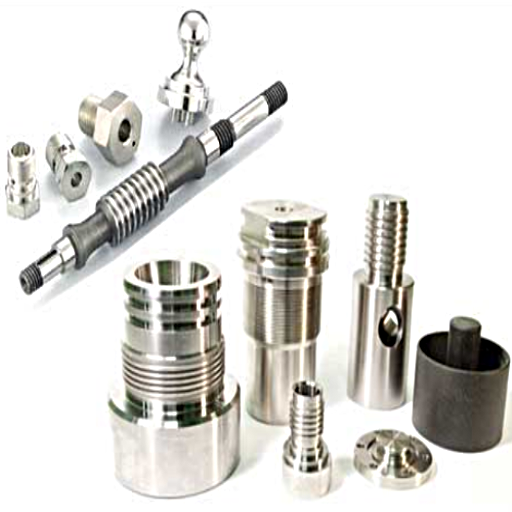
Key Benefits of Using CNC Turning Services *
All industries that seek precision, efficiency, and top-quality results could utilize these CNC turning services.
Due to their accuracy, adaptability, and strength, CNC turned parts are critical in almost all industries. They are used in the automotive, aerospace, healthcare, electronics, and industrial manufacturing sectors. For example, the aerospace sector uses CNC-turned parts to make engines and other critical structural components. These components have to be accurate and reliable. The medical industry also depends on CNC machining to manufacture personalized surgical tools and implants. The flexibility of CNC turning makes it extremely easy to produce parts that require high quality and compliance with industry benchmarks.
The exceptional precision, waste reduction, and efficiency of CNC machining services make them a solution of choice in the manufacturing sector. Automating processes using CNC machines decreases the level of manual labor needed, which over time lowers production costs. Using CNC machines has cut production time by 50% compared to traditional methods, leading to improved turnaround time and productivity.
CNC machines use advanced technology to cut, shape, and customize materials with a high degree of accuracy, improving optimization and lowering material waste. Industries that incorporate CNC technology have reported savings of 30%—40% in raw material expenditures due to reduced scrap rates, particularly when using costly titanium or stainless steels. This not only saves money but also supports sustainable manufacturing.
Increased volume of production also improves cost-effectiveness. Without losing quality, CNC machines can easily be scaled to produce thousands of identical components, significantly reducing the cost per part. This makes CNC machining incredibly useful in industries with significant production demands, including automotive, aerospace, and consumer electronics.
Finally, incorporating modern technologies such as AI and the Internet of Things into contemporary CNC machines guarantees predictive maintenance and improves operational efficiency. Such innovations AI and IoT reduce expensive interruptions caused by unexpected machine failures and minimize downtime, enabling a reliable workflow and optimized costs.
The efficiency of rapid prototyping transforms contemporary manufacturing by enabling companies to expedite their product development cycles. Due to advanced CNC machining and modern 3D printing technologies, prototyping can now be done within 24 hours. These offer quicker turnarounds, which enable greater iteration, where design and engineering teams check for functionality and issues and refine the designs within a very short time frame.
As noted in a recent report, 85% of manufacturing industry professionals strongly agree that fast prototyping services have significantly reduced time to market. Additionally, leveraging these services reduces costs associated with more traditional methods, like tools and material waste. Such advancements benefit the automotive and aerospace industries, where accuracy and speed are crucial for competitive advantage.
With the CNC machining capabilities coupled to streamlining production, your company will always meet market needs while maintaining quality and accuracy in each prototype. Whether testing a new idea or getting ready for mass production, fast prototyping provides unparalleled adaptability and efficiency for thriving in today’s market.
When choosing a CNC turning service, keep in mind the following critical aspects:
These factors will assist you in selecting a CNC turning service that works best for your project and ensures complete success.**
Confirm that the service provider can handle the specific materials you need. For example, aluminum, steel, and titanium require a certain level of material compatibility for optimal results. Providers with broader material knowledge are more likely to meet your requirements.
Examine the service provider’s machines and technology. Competent manufacturers are equipped with advanced CNC machining centers with tight tolerances and multi-axis work capabilities, greatly enhancing the quality of complex parts. Consider whether the provider uses modern cutting tools.
Review the provider’s production capacity relative to the delivery timeline. Be concerned with their ability to produce the required parts within project deadlines. Especially for high-demand or short-run projects, ensure there are quick lead times without compromising on quality.
The reliability of customer support can make or break the production process. Look for a provider who communicates clearly regarding project milestones and offers post-production support. A responsive service team can effectively manage potential problems that arise during production.
CNC turning services are widely known due to various customer needs. Review articles, customer reviews, testimonials, and case studies are some ways of assessing reliability and trust in a provider. Providers with a good reputation tend to be marked for consistently delivering quality services.
Submitting an inquiry for a custom-turned part requires careful attention to detail to guarantee accurate pricing and meet the client’s needs. Compliance with the following guidelines is essential to ensure the quote meets all expectations.
A comprehensive design sketch accompanies the order specification. This sketch should detail the sections/parts, dimensions, tolerances, materials, surface finishes, and any relevant 2D or 3D CAD files.
Designate the type of material, such as stainless steel, aluminum, or brass. Further, state specific requirements, such as grades like 316 stainless steel or 6061 aluminum. This will aid manufacturers in accurate material sourcing.
Specify how many units of each part are needed. Whether you require a small batch for prototyping or large-scale production, this will significantly streamline the quoting process.
State the production and delivery timeline expectations, noting that shorter lead times usually incur higher costs, adding complexity to the order fulfillment balance while considering delivery expectations.
State all requirements under extra finishing and post-processing, including but not limited to anodizing, heat treatment, polishing, or painting so that they can be accurately addressed in the quote.
Specify inspection requirements, such as first article or full quality inspection. If certifications, such as ISO 9001 or specific material certifications, are needed for compliance, include these as well.
If there is a specific budget or target price, mentioning it will help the provider align their capabilities with the requirements.
Research on comparable CNC machining providers shows that quotes differ greatly based on materials and complexity. For example, an aluminum part with basic tolerances costs $5-10/unit at scale. Still, intricate components that require expensive materials and significant post-processing work can cost $50 to $100+ per unit. Delivery is within the 1-4 week range for small batches, while large-scale orders may take 6-8 weeks.
Providing precise and complete details helps ensure a smoother quoting process and alignment with the provider’s capabilities.
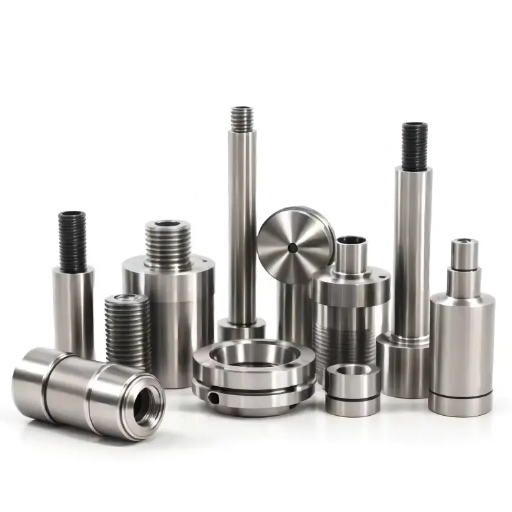
The versatility of CNC turning lies in its ability to operate on a wide array of materials. Some of the more common include:
Material selection is determined by the part’s design objectives, operational demands, physical stresses, and environmental exposure.
While stainless steel has outstanding corrosion resistance, carbon steel excels in strength, machinability, and price.
|
Parameter |
Stainless Steel |
Carbon Steel |
|---|---|---|
|
Corrosion |
High resistance |
Low resistance |
|
Durability |
Long-lasting |
Moderate |
|
Strength |
High tensile |
High compressive |
|
Machinability |
More difficult |
Easy |
|
Cost |
Expensive |
Affordable |
|
Weight |
Heavier |
Lighter |
|
Heat Resistance |
High |
Moderate |
The use of alloys in CNC turning is driven by specific mechanical and thermal properties that are improved for particular uses. For instance, aluminum alloys are used widely because of their lightweight and corrosion-resistant properties in aerospace and automotive components. Titanium alloys are also used extensively for their high strength-to-weight ratio and good biocompatibility and are frequently found in medical implants and high-performance applications. Steel alloys are popular because of their high durability and resistance to heavy stress; thus, they are used in structural and heavy machinery parts.
In CNC turning, factors such as thermal conductivity, ease of machining, and project requirements determine the most appropriate alloy. These materials, even superalloys meant for harsh conditions, are best handled with precise, advanced CNC machinery.
2. Recent Advances in Turning Processes Using Coated Tools—A Comprehensive Review
3. Surface Roughness Optimization of AL 7075 Aluminum Alloy in Hole Turning Process
4. Coaxiality Error Analysis and Optimization of Cylindrical Parts of CNC Turning Process
A: Lead times for CNC turning services can vary depending on the part’s complexity and the required volume. For high-precision projects, lead times typically range from a few days to several weeks. Parts can often be produced in as fast as 24-48 hours for rapid prototyping.
A: The CNC turning process involves using a CNC lathe to remove material from a rotating workpiece to create precision turned parts. The material is shaped into the desired shape through subtractive machining operations, including drilling and live tooling.
A: Precision CNC turning services can handle a variety of materials, including both metal and plastic parts. Common materials include aluminum, steel, brass, and various thermoplastics, allowing high-quality parts tailored to specific applications.
A: Our CNC turning machines have advanced turning capabilities that allow for the high-precision machining of cylindrical parts. We offer custom CNC setups that accommodate various sizes and complexities, ensuring high-quality finished parts.
A: High precision in turned parts is achieved through carefully programming the CNC turning process and using high-quality CNC turning centers. Our team utilizes advanced software and tools to monitor and adjust the machining process, ensuring the final products meet stringent specifications.
A: The main difference between CNC turning and CNC milling lies in the machining. CNC turning primarily creates cylindrical parts by removing material from a rotating workpiece. At the same time, CNC milling involves moving a stationary workpiece against a rotating cutting tool to remove material. Both processes can be used to produce high-precision parts.
A: CNC turning supports parts manufacturing for rapid prototyping by allowing quick adjustments and iterations during production. With CNC technology, we can produce prototypes efficiently, enabling faster design development and testing before full-scale production.
A: Precision turned parts are used in various industries, including automotive, aerospace, medical, and electronics. They are essential components in machinery, equipment, and devices requiring high precision and reliability.
A: To learn more about our precision CNC turning services or discuss your project needs, please visit our website or call our customer service team. We are here to help you with any questions regarding parts manufacturing and turning capabilities.

Manufacturing processes are quite complex, and the choice of a production method is directly related
Learn More →
There are two major manufacturing methods for producing plastic prototypes that most people find useful
Learn More →
As a person involved or interested in the design and production of plastic components, it
Learn More →