

Manufacturing processes are quite complex, and the choice of a production method is directly related
Learn More →
When making in regard of CNC machining, it is important to figure out the difference in operation of 3-axis as compared to 4- and 5-axis machines so as to know which approach to best apply in the manufacturing process. With this in mind, all of the machines are meant for different kinds of component building, and each one of them is able to carry out different types and precision levels of machining. So how do these distinctions occur and which type of machine should be used? This text seeks to explain the structures and the differences between these axis and many more with examples. There is no reason to assume that only proficient specialists will find the reading worthy because even a beginner in CNC technology will find the reading worthy which will enhance decision making for optimum productivity and quality in a CNC Machining process.

CNC adding machine, that is to say computer numerical control machining, can be explained as a manufacturing option whereby coded programs and software manage the machines and tools to produce the desired parts. Also, this process differs from traditional machine operations by the fact that CNC machines are operated without the intervention of the machine operators himself as the machine tool is guided by a computer program. Such machines are usually utilized in activities such as cutting, grinding, drilling, milling and turning of different materials like metal, wood, plastic to mention but a few examples. Depending on the type of design, material of construction and the final product, it becomes important for such types of industries to embrace CNC technology as a method of engineering a product with precision and efficiently manufacturing it in large numbers.
The CNC (Computer Numerical Control) machining is an industrial process that employs computer-aided software, specifically after programming, to control the motion of all tools and machinery present within the factory. With this technology, material including metal, plastic, wood, and even composites can be processed into very robotically shaped and coated objects. CNC machining has been adopted by many sectors because it generates complex shapes with a very high level of precision and consistency.
The method usually comprises a number of stages such as creating the design of a component in CAD (Computer-Aided Design) system, transforming it into a G-code that can be performed by the machines, and running the toolpath scuttles on the CNC systems such as turning or milling centers. In fact, efficiency and innovation in today’s surrounding appropriate manufacturing processes will only continue with the application of CNC machining which is a segue of multiple aspects of work and the appropriation of even than 5axis machines.
Building on the age of CNC machines they can be classified into many types attending to various manufacturing needs. The basic types are:
Every such machine is taken to the next level by contemporary inventions such as 3-Axis vs 4-Axis vs 5-Axis CNC Machining & intelligent software applications which make them usable across the industries with ease.
Choosing the suitable axis arrangement for the CNC machine is significant. It will affect the operations with respect to the speed, accuracy, and even some aspects of the versatility of the machine. It ranges in either 3, 4, or 5 axis configurations. Each configuration is adapted for distinct purposes. Simple applications such as drilling and cutting surfaces require a 3-axis machine only. However, industries seeking greater precision such as aviation or manufacture of medical equipments require mechanism or systems capable of four or five axes which permit the changing of the angles without disorienting the workpiece.
Compact industries more often than not seek changes in structure and quick reconfigurations other wise both are brought about by enhancement of Multiaxis machineries. Deciding the correct axis configuration helps to provide improved quality levels, less material wastage, and faster throughput thereby making any business dominating in the contemporary competitive markets.

At the jobs’ early stage the 3-axis CNC machining was practiced. The tool motion is defined by three axes taking a turn in either X, Y or Z direction. This machine is suitable for simple operations like drilling, milling and tapping which are conducted on plain structures. There is no doubt that a 3-axis machine system is one of the most reliable ways for mass production, especially for complex parts, but still enables the fabrication of simple few parts. Machine remains compact for most of machining applications and has high accuracies in most machining processes.
3-axis CNC machining employs CNC (computer-numerical-control) to control a cutting tool moving along those primary axes- X, Y, and Z. These axes allow for precision movement and shaping of materials, good for applications like drilling, milling, and shaping flats or moderately complex surfaces. The direction of X is parallel to the bed, Y orients vertically, while Z lies along the axis, perpendicular to the bed. This sort of Cartesian CNC system is broadly used to cater to industries that want simplistic geometries: simplicity plus accuracy plus reliability-a cost-effective combo.
3-axis CNC systems are great for applications where simplicity and speed are prioritized. They are good for the production of parts with flat surfaces or basic contours like housings, plates and fixtures. Operating such machines typically consists of manual programming or using a Computer Aided Manufacturing (CAM) package to generate toolpaths. They are popular for prototypes, small-batch production and entry-level machining requirements because of their accessibility and affordability.
Three-axis milling has been in demand across various industries due to its versatility and precision. The general applications of the milling include the production of simple-to-moderately-complex parts such as brackets, housings, and panels. Three-axis milling is, however, only good for tasks that involve milling of flat surfaces, drilling holes, and creation of basic cavities. The industries, aerospace, automotive, and consumer goods, rely on 3-axis machining for prototyping and small-batch manufacturing, where speed and cost matter, mostly. Besides that, it is used constantly in the domain of custom fabrication projects and in educational settings where machining fundamentals are taught.
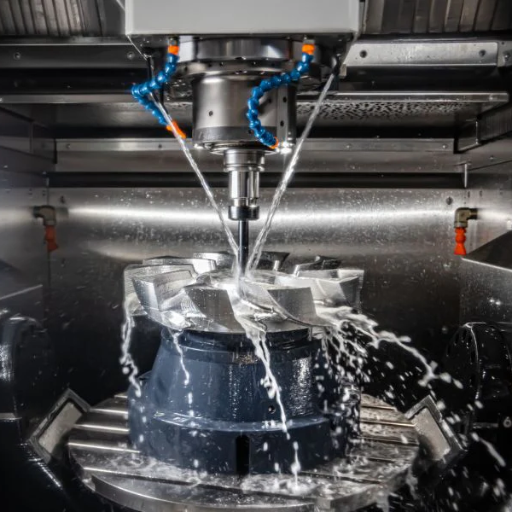
4-axis machines employ the capabilities provided by the 3-axis machines by introducing a rotation which is normally referred to as the A-axis. The additional axis enables the enhanced capacities of 4-axis machine, like machining on different planes of a part without repetitive repositioning, handling of parts with complex geometries significantly more efficiently; undercutting geometry or a surface with curve in profile can be handled. As a further benefit, 4-axis milling provides a narrower accuracy with little time wastage as far as complex designs are concerned, and that is ideal for industries like aerospace, automotive, and medical device manufacturing.
4-axis CNC machining is technically more advanced compared to 3-axis CNC machining because such 4-axis system adds rotary movements on an additional axis, such as a rotary table. This feature enables the workpiece to rotate around a fixed-axis, which, in return, allows inclined cuts, milling, and cutting across complex geometries. The techniques involving these additional axes often make the operator more effective and increase the precision of producing jigs simply outweighing the benefits of removing such jigs. In finding suitable applications for specialized professionals from the aerospace, automotive, and medical sectors, 4-axis machining will produce intricate components with extreme precision in much less time.
The key differences between 3-axis and 4-axis CNC machines lie in the number of axes, rotational capability, machining complexity, efficiency, and application scope.
| Parameter | 3-Axis CNC | 4-Axis CNC |
|---|---|---|
| Axes | 3 | 4 |
| Rotation | None | Adds 1 rotating axis |
| Complexity | Lower | Higher |
| Efficiency | Moderate | High |
| Repositioning | Required | Not required |
| Applications | Basic parts | Intricate parts |

5-Axis CNC machining defines such a scenario where a machine’s tool or object is passed through five different axes simultaneously. As a result, much precision and the ability to machine complicated shapes in one setup come in with it. It has five axes-the standard X, Y, and Z linear movements plus two others for rotations. Such a feat minimizes the intervention of numerous setups, cuts down on blunders, and improves productivity, making it the solution to the needs of sectors supplying intrinsically intricate or fine-class components.
The main advantage of 5-axis CNC technology lies in the capacity of generating very complex and precise parts in fewer setups compared to the traditional three-axis machines. The two additional axes of rotation grant the manufacturer an opportunity of way smoother surfaces, reducing machining time and enhancing geometric tolerance. In practical terms, this technology will be very useful in developing highly complex designs that are most required in the aerospace, car, and medical businesses wherein accuracy and efficiency are paramount. It should be noted that, by reducing manual intervention and repositioning, 5-axis CNC machines lower the chances of error thus streamlining the production process for intricate parts.
5-axis CNC machining offers greater flexibility, speed, and precision compared to 3-axis CNC machining, which is more limited in movement and complexity.
| Parameter | 5-Axis | 3-Axis |
|---|---|---|
| Flexibility | High | Moderate |
| Speed | Faster | Slower |
| Precision | Superior | Basic |
| Movement | Multi-angle | Linear |
| Complexity | High | Limited |
| Setup Time | Less | More |
| Human Error | Reduced | Higher |
| Applications | Complex parts | Simple parts |

3-axis, 4-axis, and 5-axis CNC systems differ in movement, precision, complexity, and application scope.
| Parameter | 3-Axis | 4-Axis | 5-Axis |
|---|---|---|---|
| Movement | X, Y, Z | X, Y, Z + Rotation | X, Y, Z + 2 Rot. |
| Precision | Moderate | Higher | Superior |
| Complexity | Basic shapes | Moderate shapes | Complex shapes |
| Tool Access | Limited | Improved | Maximum |
| Cost | Lower | Moderate | Higher |
| Setup Time | Longer | Shorter | Minimal |
| Applications | Simple parts | Cylindrical parts | Complex designs |
| Surface Finish | Standard | Better | Best |
| Collision Risk | Higher | Lower | Minimal |
When discussing the differences between 3-, 4-, and 5-axis CNC machining systems as regards their movement capabilities, efficiencies, and the kind of part they can yield, we set certain benchmarks:
This considers movement along the X, Y and Z axes, suitable for simpler parts with flat faces. However workpieces require manual repositioning after a side is machined, which delays setup time and increases chances of error.
Accomplished by the provision of movement along the A-axis (rotation about the X-axis), machining of cylindrical or multiply extruded parts now benefits from added convenience since the position of pieces is altered automatically while continuing the machining process, which is beneficial both in terms of increase of precision and reduction of setup-completing time compared with the 3-axis CNC.
This new stage includes two extra rotational axes (A and B) to allow the tool access to the workpiece from nearly any direction best suited for intricate and complex designs, like the ones in aerospace or medical. The setup time is unimportant and the precision and surface finish are excellent.
The selection among these options depends on the complexity, precision, and cost requirements of the project.
When considering a cost analysis for a 3-axis, 4-axis, and 5-axis CNC machine, one is usually allowed to look at the initial cost side by side with the day-to-day costs/counting over the years. As opposed to 5-axis CNC machines, which have fewer zeroes in cost of purchase and in maintenance. All of the first three machines are for lesser production runs and lower-complex designs. The 3-axis CNC machine is the cheapest solution, with less need for high purchase prices and a simpler maintenance regimen. These machines are the most appropriate for simple designs and less-complex components and are the cheapest option for engaging in many but not all small- to medium-scale production runs.
However, along with some additional investment to acquire a 4-axis CNC machine, the primary investment is directed toward adding more functionality-and ideally, that is its main scope of operation. The added functionality on a 4 axis is the capability to let the shaft rotate during the cutting process. The cutting processes of cylindrical components or those with a certain rotational aspect are accomplished. Despite the substantially nominal cost increase for these added features, the machine provides the right cut at a wonderfully balanced cost for companies seeking flexibility.
5-axis CNC machines represent the highest high end and, simultaneously, the most expensive, with substantially higher initial investment costs and more headaches over operation. But this means that, since its precision is unparalleled and its flexibility allows manufacturers to originate the most involved, delicate, and intricate illustrations with little or no manual input, industries like aerospace and medical can virtually not do without it.
Ultimately, the choice among these CNC machines will all depend on the specific project needs and budget constraints, whether any production targets have been established. While the entry-level machine can offer costs that are less expensive, the costs of the 4-axis and 5-axis machines might pay off for the related capability through a cutting down in time for setting up machines and the ability to handle highly complex works efficiently.
It is vital to make the right choice of CNC machine based on the kind of work involved, budget, and output requirements. The simultaneous three-axis CNC machine works extensively for simple structures instead of costly three- and five-axis CNCs. Four-axles allow extra movement along with detailing, whereas five-axle models are especially accurate and productive for doing critical details in aerospace or medical-field components. Weighing technology advantage over need will help conclude best results. This should be most productive and cost-effective effort.
There are several different aspects of operation with regard to the axes that come into play when attempting to distinguish between 3 Axis, 4 Axis and 5 Axis CNC machining. With 3-Axis machining, the cutting tool moves linearly, meaning along 3 linear sets of axes (XYZ) for creat- ing parts that have only planar milled profiles or simple pockets. 4-Axis machining adds one A-Axis (a rotary axis), where the part and cutting plate are able to rotate. This makes it more likely that the milling machine will be able to exert cutting from all the sides without being repositioned by hand. 5-Axis machining adds 2 more axes that can rotate components (referred to as B and C axes). These diff. axes let the cutting tool to not only move, but tilt as well, so that new surface features can be machined with great accuracy and are cut free from inside. Moreover, this method minimizes the necessity for multiple setups and extends the range of application of these machines.
Three-axis milling is best for parts that have most of their geometry defined by three linear dimensions, like flat surfaces, slots, lobed holes on a single face, and planar profiles. The simpler programming of 3-axis milling machines and the fact that no other component is added, make them suitable for low-cost, high volume, repeatable machining jobs, where only x, y, and z movements of the cutter are required and there is no tilt or rotation of the part.
The 5-axis machine gives great flexibility of operation because it enables the cutting tool movement and tilting around two more rotation axes–the b-axis and c-axis–thus allowing accurate angular feature machining and smooth side-to-side finishes, or maybe fewer setups, and machining of deep cavities and undercut features which a 3-axis machine is unable to reach. The two main 5-axis configurations are integrated table and head-type. Alternatively, their CNC machining helps reduce cycle times and has improvements on tool life through more optimal tool orientation.
Not always. Although they are capable of handling a wider variety of components–the more axes, the greater the complexity–4-axis milling and also 5-axis milling are often chosen based on part design and setup considerations Damaged parts, high-volume cases, or where the cutting tool moves only along any of the three axes seem on the other hand to be best served by inexpensive, 3-axis machines. 4- or 5-axis machining is desirable for parts requiring angled features, multiple sides, and complicated surface contours but such advantages do not come without added expense and higher programming requirements.
Considerations for engineers with respect to the question of purchasing are regarding the complicated nature of the part, tolerance as well as surface finish requirements, the production volume, and the cost vs. lead time tradeoffs. Moreover, the consideration must be made whether the features are required on separated out sides, will cut tools at angles, or require undercuts, or whether it would beneficial to reduce setups. Regarding the simple parts having only one flat surface, 3-axis machining is considered sufficient; however, the solution with 4-axis capability may be the most beneficial whenever the number of features is poached throughout more sides of the part (4 or greater) and may go well down to the side with more number of sides. More complexly designed parts with contouring or angled features will best be suited with full 5-axis machine capability. The existing skill of the programmer, cost, and flexibility of the machines should be assignated against the kind of machining to be expected.
Three and Five Axes Milling of Sculptured Surfaces – This paper compares the performance of 3-axis and 5-axis CNC milling for sculptured surfaces, highlighting technological differences and applications.
A Hybrid 5-Axis CNC Milling Machine – Research on the design and advantages of hybrid 5-axis CNC machines, including comparisons with 3-axis and 4-axis systems.
Design and Fabrication of a PC-Based 3-Axis CNC Milling Machine – A study on the design and development of 3-axis CNC milling machines, with references to 4-axis and 5-axis advancements.
This comprehensive guide endeavors to aid manufacturers and engineers understand the differences concerning 3-axial, 4-axial, and 5-axial CNC machining. It aims to support the production such that the ultimate production in both high precision and ultimate precision in CNC machining is achieved through well-informed decisions being taken.

Manufacturing processes are quite complex, and the choice of a production method is directly related
Learn More →
There are two major manufacturing methods for producing plastic prototypes that most people find useful
Learn More →
As a person involved or interested in the design and production of plastic components, it
Learn More →